Triage is a necessity in the medical world and is often a matter of life and death. In the world of theology it can also mean spiritual or physical life and death. In the last post on this topic, we considered the importance of fleshing out the brilliant statement by Rupert Meldinius in the 17th Century about church cooperation. He wrote, “In essentials, unity; in nonessentials, liberty; in all things, charity.”1 His statement invokes the need to think about theology in prioritized categories. Gavin Ortlund and Al Mohler prescribe several ways to rank theology. Both Mohler and Ortlund have similar categories for one to three, while Ortlund adds a fourth. They both encourage us to think of processing theology in terms of primary, secondary, and tertiary issues. Ortlund adds a fourth category, which he refers to as adiaphora or “indifference”.
In review, primary doctrines are essential to the Gospel. Secondary doctrines are essential to the health of an individual church or denomination, but not directly to the integrity of Gospel. Third rank doctrines are still important to portions of theology, but should not divide believers. Finally, fourth rank doctrines adiaphora are unimportant to the gospel altogether. These are convictions born of preference and opinion.
The focus in this post is to consider how theological triage can be compromised, misapplied, and resolved historically in the church. For the past 2000 years, the church has relied upon Church Councils, Creeds, and Confession Statements to apply triage and maintain unity. Additionally, certain writings of believers have clarified primary and secondary issues. However, there was still much confusion over how to apply these categories in church history. Sometimes the misapplication resulted in exile and death.
In the first eight centuries of the church there were seven ecumenical councils. They began in 325 with the First Council of Nicaea and ended in 787 with the Second Council of Nicaea. These councils were formed to root out error and maintain first-rank theological concerns. For example, in the First Council of Nicaea in 325, Arius, a priest from Alexandria, was teaching that Jesus was created by the Father. He believed and taught that the Father was greater than the Son. Alexander of Alexandria argued that Jesus was begotten of the Father, not created and was fully equal with the Father. The council agreed with Alexander and the divinity of Jesus was preserved in the local church. 2 In this case, theological triage prevailed and preserved. The Council sided with the orthodox, composing the first form of what would become known as the Nicene Creed. 3Throughout the next few centuries a pattern arose with a false-teaching proclaimed, a church council formed to address it, and an orthodox conclusion reached to maintain first-rank theological issues. Some had to do with the humanity of Christ and others the Divinity of the Holy Spirit.
Another way that theological triage sustained the church was by the use of explicit creeds and confessions. Archibald Alexander defines a creed as “the systematic statement of religious faith; and by the creeds of the Christian church we mean the formal expression of “the faith which was delivered unto the saints.”4 The most well known of the Creeds are the Apostles Creed and the Nicene Creed. The Apostles Creed is the most well known of Creeds and is often referred to as the Creed of Creeds. 5 The creed represents apostolic gospel teaching in summary form. For example, The Apostle’s Creed has a wonderful statement about the Trinity, which should always remain a first-rank theological issue essential to the gospel.
The Church and its leaders do not always get theological triage correct. In fact, even when they do see sort out primary from secondary, they sometimes misapply their convictions overzealously and violently. Mode of Baptism in the 16th century was example of this confusion and chaos. As we have alluded in the last post, a specific mode of baptism is often considered to be a secondary issue in theological triage. However, during the time of the anabaptist it was first-rank theological issue. The question was not whether or not to be baptized, it was the timing and mode of baptism. It is hard for us to imagine religious leaders so dug into baptism that they were willing to physically punish those who disagreed by killing them. However, that was the position of the Roman Catholic Church and many protestant believers in the 16th Century. Ulrich Zwingli, a contemporary of Martin Luther, was pro-reformation, but not as radical as some of the anabaptists in his attempts to revitalize the doctrine of paedobaptism. Felix Manz, was a friend of Zwingli’s, but the two could not agree on baptism. W.S. Reid explains the tension between the two men. He writes:
Manz, however, came to reject Zwingli’s view that the ultimate authority in any reform movement must be the civil authorities, and he did not accept the other reformers’ distinction between the “visible” and the “invisible” church—i.e., those who professed faith and those who truly did believe. He believed that the church must be made up of only those who have true faith in Jesus Christ as Savior. Therefore, he denied the right of infants to baptism. 6
This was a struggle for Zwingli and those he considered his brothers. Christian History Magazine summarizes the tension he felt.
Zwingli apparently felt the choice was between orderly change and ecclesiastic anarchy. He urged moderation and patience and engaged the radicals in a series of public debates, but when the radicals began re-baptizing in February, 1525, he sided with the Council in its decision to outlaw private meetings and require that all children be baptized. 7
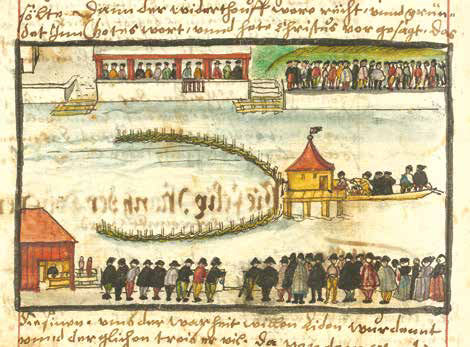
The final day for the first anabaptist martyr came on a cold day in 1527. The Roman Catholic Church passed a verdict of guilty upon Felix Manz, and sentenced him to death by drowning the River Limmit. Zwingli was silent and did not oppose his sentence or punishment.
Meldinius’ statement emerges from the depths of the ice River Limmit. “In essentials, unity; in nonessentials, liberty; in all things, charity.” In Felix Manz’ case, there was no liberty and charity. In our theological triage, we must hold our convictions firmly and with grace toward those who disagree; especially on secondary matters.
- https://www.ligonier.org/learn/articles/essentials-unity-non-essentials-liberty-all-things/ ↩
- https://www.challies.com/articles/7-councils-the-first-council-of-nicaea/ ↩
- Brett Scott Provance, Pocket Dictionary of Liturgy & Worship, The IVP Pocket Reference Series (Downers Grove, IL: IVP Academic, 2009), 43. ↩
- Arch. B. D. Alexander, “Creed, Creeds,” ed. James Orr et al., The International Standard Bible Encyclopaedia (Chicago: The Howard-Severance Company, 1915), 741. ↩
- https://www.thegospelcoalition.org/article/9-things-know-apostles-creed/ ↩
- W.S. Reid, “Manz, Felix,” ed. J.D. Douglas and Philip W. Comfort, Who’s Who in Christian History (Wheaton, IL: Tyndale House, 1992), 451. ↩
- “A Gallery of Family, Friends, Foes, and Followers,” Christian History Magazine-Issue 4: Zwingli: Father of the Swiss Reformation (Worcester, PA: Christian History Institute, 1984). ↩
Discover more from Valley Shepherds
Subscribe to get the latest posts sent to your email.
 Valley Shepherds